
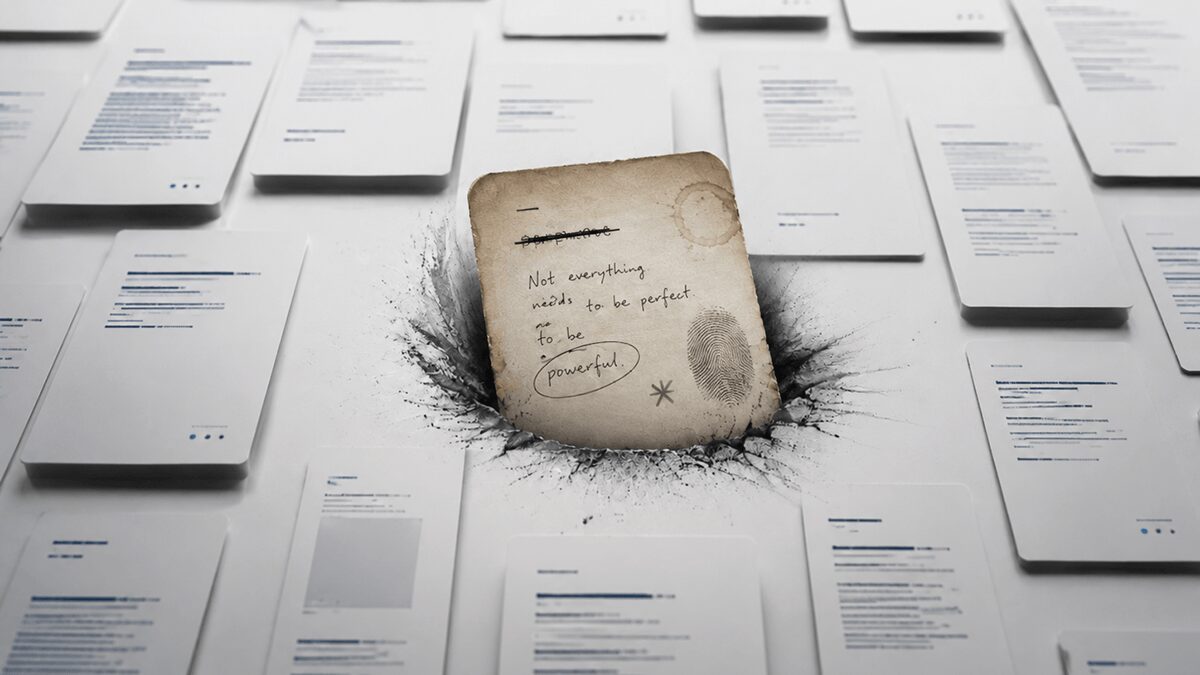
Why it got harder to leave a mark exactly when content got easy to make
"In today's evolving digital landscape, artificial intelligence is changing the rules of the game, empowering organizations to produce high-quality content with unprecedented speed and efficiency. To stay relevant in a competitive market, companies must embrace innovative tools, leverage the advantages of technology, and deliver real value to their audiences…"
Now stop for a second.
Did you read that paragraph?
If we had to bet, probably not. Your eyes passed over it the way they pass over the terms of service - moving, not landing. Nothing in there caught you. Nothing made you stop. Nothing made you think.
And there's a reason. There isn't a single sentence in it you haven't seen five hundred times. Not one detail that cost anyone anything to write. We generated it in three seconds, and it's accurate, polished, grammatically perfect - and completely forgettable.
That, in one paragraph, is the paradox. In the flesh.
An AI named Tony
Walk into any company right now and someone will tell you about their AI setup. One founder has AI practically running operations. Another automated the entire marketing function overnight. And then there's the AI that writes the pitch decks - and this one, they'll insist, is different. This one actually gets the company. Understands the voice. It even has a name.
His name is Tony.
And look - Tony's good. We won't pretend otherwise. Honestly, we use Tony too. This isn't a lecture from someone standing above it all.
But here's the thing: everyone has a Tony.
That's exactly where the problem starts. Because when Tony sits down to write, he doesn't remember the meeting with your first investor. The one where, after the deck was done, the guy leaned back and asked the only question that mattered: "But how do you actually know it works?"
And instead of pulling up another graph, you told him the truth. You'd put the first version in front of your mother-in-law, and she used it twice without a single complaint. "In my family," you said, "that's a standing ovation."
He laughed. He leaned in. He signed.
Tony knows how to write "the product underwent rigorous validation with end users."
Tony never met your mother-in-law.
What actually leaves a mark
So what makes one idea lodge in someone's head while a hundred others evaporate by lunch?
What makes a presentation get remembered?
What makes an investor decide you're worth the bet?
Short answer: exactly the thing AI can't generate for you.
The name. The date. The story only you know. The moment you got it wrong and learned something that cost you. The friction. The detail that couldn't have been invented — because the only person in the room was you.
Specificity. Friction. A character.
That's the whole engine of a good story.
Try it yourself. Take a scene from a film you love. Now strip out the character's name, where they're from, what they want. Picture it again. What's left is a few people in a room exchanging meaningful looks at nothing. That's not a scene - it's a diagram. And you've already forgotten it. Because what moved you was never the structure. It was the story sitting inside it.
Three mistakes to avoid
A little practical advice on what not to do.
Don't trust the polish. When AI smooths your writing until it sounds "professional," it's sanding off the exact bumps that would have made someone remember it. Smooth is forgettable. The rough, specific, slightly-too-personal part is the part that's actually yours. Keep it.
Don't confuse volume with presence. Yes, you can produce ten times as much now. That's not the flex you think it is. Ten decks nobody remembers isn't presence in the market - it's noise with a logo on it.
Don't outsource the part only you know. Let Tony pull the market data. Great use of him. But the insight that exists only because you sat through a hundred meetings to earn it? That's the moment to stop typing and think. Don't ask for a rewrite. Try to remember.
A test you can run today
Open the last deck you made. Read it line by line. Delete every sentence that could appear, word for word, in a competitor's deck.
Whatever's still standing when you're done — that's the real thing. Keep it.
And if the page is nearly empty? You just found your problem. Start over from what's left.
Good stories are worth more now, not less
The assumption is that AI made storytelling cheap. It did the opposite.
When content costs nothing to produce, the scarce thing becomes the only thing that was ever actually scarce: attention, memory, and the decision that comes out the other side.
And in the moments that count — the investor conference, the launch, the leap into a new category, the new leadership walking in for the first time — nobody is going to remember that your deck was competent. They'll remember one of two things. That you left a mark. Or that you were the twentieth version of the same thing to come through the door that day.
The tool makes the content.
You're the one who leaves the mark.
That difference is the whole game.







contact us!



Developed by :
Powered by :